The Jewish year: holidays, months and Shabbat
27 festivals, fasts and other days of the Jewish year, from Tishrei to Av: what each one is and what to expect if you are in Israel, with the greeting where there is one. Then the months and Shabbat.
The year at a glance
Dates are for the Hebrew years 5787 and 5788, as kept in Israel. Dates already past when this page was built are left out.
| Name | Kind | Hebrew date | Dates in Israel |
|---|---|---|---|
| Tishrei תִּשְׁרֵי | |||
| Rosh Hashanah | Festival | 1-2 Tishrei | 2-3 October 2027 |
| Tzom Gedaliah | Fast | 3 Tishrei | 4 October 2027 |
| Yom Kippur | Festival | 10 Tishrei | 11 October 2027 |
| Sukkot | Festival | 15-21 Tishrei | 16-22 October 2027 |
| Hoshana Rabbah | Minor day | 21 Tishrei | 22 October 2027 |
| Shemini Atzeret | Festival | 22 Tishrei | 23 October 2027 |
| Simchat Torah | Festival | 22 Tishrei in Israel, 23 Tishrei in the diaspora | 23 October 2027 |
| Kislev כִּסְלֵו | |||
| Chanukah | Minor day | 25 Kislev to 2 or 3 Tevet | 5-12 December 2026 25 December 2027 to 1 January 2028 |
| Tevet טֵבֵת | |||
| Asarah B’Tevet | Fast | 10 Tevet | 20 December 2026 9 January 2028 |
| Shevat שְׁבָט | |||
| Tu BiShvat | Minor day | 15 Shevat | 23 January 2027 12 February 2028 |
| Adar I אֲדָר א׳ | |||
| Purim Katan | Minor day | 14 Adar I, in leap years only | 21 February 2027 |
| Adar אֲדָר | |||
| Ta’anit Esther | Fast | 13 Adar, Adar II in a leap year | 22 March 2027 9 March 2028 |
| Purim | Minor day | 14 Adar, Adar II in a leap year | 23 March 2027 12 March 2028 |
| Shushan Purim | Minor day | 15 Adar, Adar II in a leap year | 24 March 2027 13 March 2028 |
| Nisan נִיסָן | |||
| Pesach | Festival | 15-21 Nisan in Israel, 15-22 Nisan in the diaspora | 22-28 April 2027 11-17 April 2028 |
| Sefirat HaOmer | Minor day | 16 Nisan to 5 Sivan | 23 April to 10 June 2027 12 April to 30 May 2028 |
| Yom HaShoah | Modern | 27 Nisan | 4 May 2027 24 April 2028 |
| Iyar אִיָּר | |||
| Yom HaZikaron | Modern | 4 Iyar | 11 May 2027 1 May 2028 |
| Yom HaAtzmaut | Modern | 5 Iyar | 12 May 2027 2 May 2028 |
| Lag BaOmer | Minor day | 18 Iyar | 25 May 2027 14 May 2028 |
| Yom Yerushalayim | Modern | 28 Iyar | 4 June 2027 24 May 2028 |
| Sivan סִיוָן | |||
| Shavuot | Festival | 6 Sivan in Israel, 6-7 Sivan in the diaspora | 11 June 2027 31 May 2028 |
| Tammuz תַּמּוּז | |||
| The Three Weeks | Minor day | 17 Tammuz to 9 Av | 22 July to 12 August 2027 11 July to 1 August 2028 |
| Shiva Asar B’Tammuz | Fast | 17 Tammuz | 22 July 2027 11 July 2028 |
| Av אָב | |||
| Tisha B’Av | Fast | 9 Av | 12 August 2027 1 August 2028 |
| Tu B’Av | Minor day | 15 Av | 18 August 2027 7 August 2028 |
| Every month | |||
| Rosh Chodesh | Minor day | 1 of every Hebrew month, with the 30th of the month before it where there is one | Cheshvan: 31 October to 1 November 2027 |
Rosh Hashanah
רֹאשׁ הַשָּׁנָה Rosh HaShanah
Festival
The head of the year: shofar, sweetness and an honest accounting.
- Hebrew date
- 1-2 Tishrei
- Dates in Israel
- 2-3 October 2027 Hebrew year 5788
- Greeting
- שָׁנָה טוֹבָה Shana Tova A good year
Rosh Hashanah opens the Hebrew year and the ten days of repentance that close on Yom Kippur. The shofar is sounded on both mornings, though not when the day falls on Shabbat. Meals begin with apple dipped in honey, and many spend long hours in synagogue. Unusually among the festivals it is kept for two days in Israel as well as in the diaspora.
If you are in Israel
Israel closes for two days: no buses or trains, most shops and restaurants shut, roads quiet apart from the rush before it starts. Book intercity travel around it rather than through it.
Tzom Gedaliah
צוֹם גְּדַלְיָה Tzom Gedalyah
Fast
A dawn to nightfall fast for the murder of Gedaliah and the end of Judean self-rule.
- Hebrew date
- 3 Tishrei
- Dates in Israel
- 4 October 2027 Hebrew year 5788
Gedaliah ben Achikam was appointed governor over the Judeans left in the land after the Babylonian destruction, and his assassination ended the last remnant of Jewish self-government there. The fast runs from dawn to nightfall on 3 Tishrei, the day after Rosh Hashanah, and moves to the 4th when the 3rd falls on Shabbat. It is one of the four minor fasts tied to the destruction of the Temple, and many Jews today do not keep it.
If you are in Israel
Nothing closes. Buses and restaurants run as normal, and the only sign of it is that some people you meet will not eat until after dark.
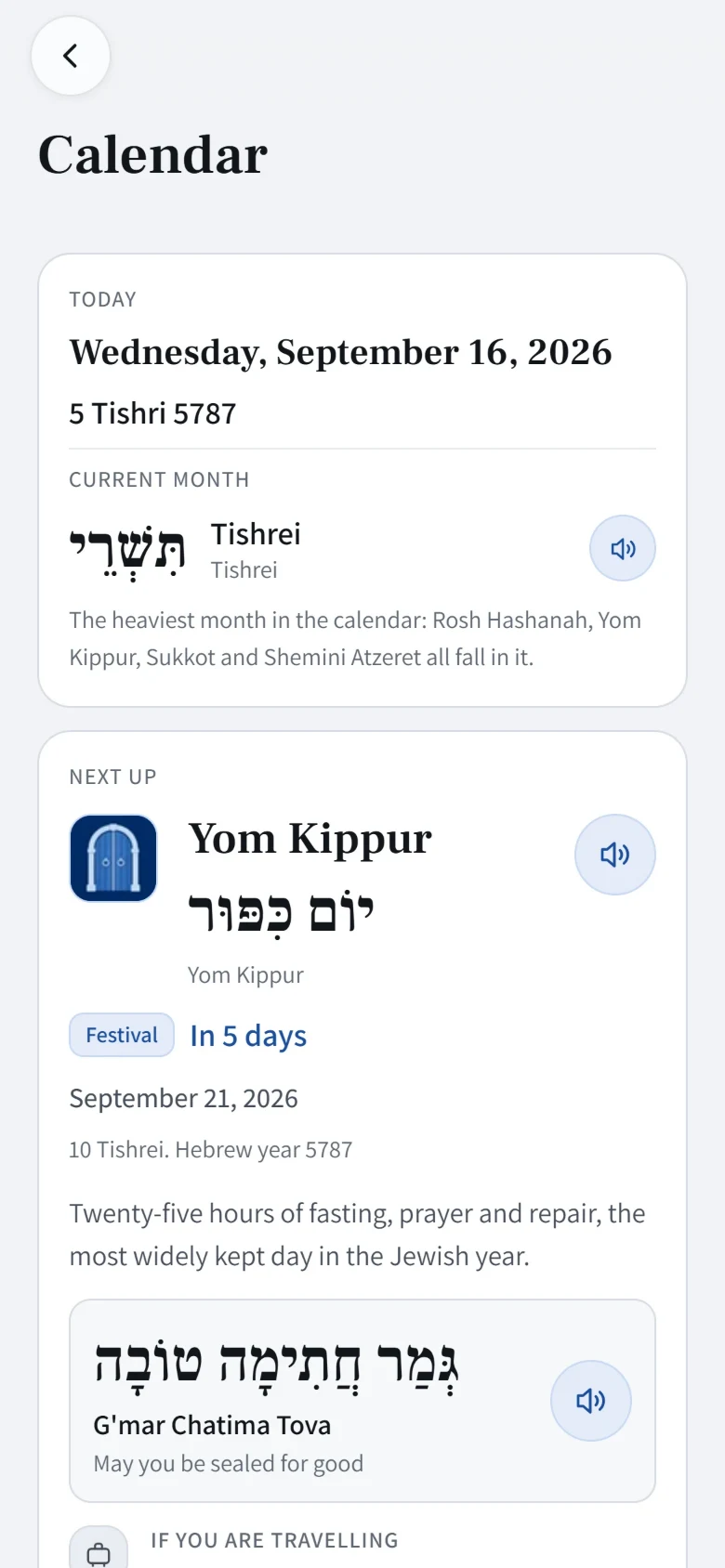
Yom Kippur
יוֹם כִּפּוּר
Festival
Twenty-five hours of fasting, prayer and repair, the most widely kept day in the Jewish year.
- Hebrew date
- 10 Tishrei
- Dates in Israel
- 11 October 2027 Hebrew year 5788
- Greeting
- גְּמַר חֲתִימָה טוֹבָה G’mar Chatima Tova May you be sealed for good
Yom Kippur is a full fast from sundown to nightfall the next day, spent largely in synagogue, from Kol Nidrei through the closing Neilah service and a single long blast of the shofar. Traditional practice adds abstaining from washing, leather shoes and marital relations, and many wear white. It is one day in Israel and in the diaspora alike, and it is kept in some form by a great many Jews who observe nothing else all year.
If you are in Israel
Israel stops completely. No flights, no buses, no trains, no television or radio broadcasting and almost no cars, so the motorways fill with children on bicycles. Be wherever you intend to sleep before sundown.
Sukkot
סֻכּוֹת
Festival
A week in a temporary hut, with the four species and the first prayers for rain.
- Hebrew date
- 15-21 Tishrei
- Dates in Israel
- 16-22 October 2027 Hebrew year 5788
- Greeting
- חַג שָׂמֵחַ Chag Sameach Happy festival
For seven days many families eat, and some sleep, in a sukkah: a booth roofed with cut branches loose enough to see the sky through. The lulav and etrog are held together and waved during morning prayers. The first day is a full festival, the first two in the diaspora, and the days after it are chol hamoed, a half-holiday when most work is permitted.
If you are in Israel
The busiest domestic travel week of the Israeli year. National parks, hotels and the Old City are packed and need booking well ahead. Buses run on the intermediate days but not on the festival days at either end.
Hoshana Rabbah
הוֹשַׁעְנָא רַבָּה
Minor day
The seventh day of Sukkot: seven circuits, and willow branches struck on the floor.
- Hebrew date
- 21 Tishrei
- Dates in Israel
- 22 October 2027 Hebrew year 5788
Hoshana Rabbah closes Sukkot with seven circuits around the synagogue carrying the four species, after which a bundle of willow branches is beaten against the ground. Tradition treats it as the last sealing of the judgement opened at Rosh Hashanah, and some stay up the night before to study. Work is permitted, and Sephardi and Ashkenazi communities differ in the melodies and in the order of the prayers.
If you are in Israel
Still chol hamoed, so shops and buses run. Synagogues are full in the morning and the Old City is crowded from early on.
Shemini Atzeret
שְׁמִינִי עֲצֶרֶת
Festival
The eighth day: a separate festival attached to the end of Sukkot.
- Hebrew date
- 22 Tishrei
- Dates in Israel
- 23 October 2027 Hebrew year 5788
- Greeting
- חַג שָׂמֵחַ Chag Sameach Happy festival
Shemini Atzeret is its own festival rather than a day of Sukkot, and it carries the year’s first formal prayer for rain. In Israel it is one day and includes Simchat Torah; in the diaspora it is the first of two days, with Simchat Torah on the second. Many communities also say Yizkor, the memorial prayer, on this morning.
If you are in Israel
A full festival day in Israel: no buses or trains, shops shut, and it runs straight on from Sukkot. In the diaspora it is the first of two closed days.
Simchat Torah
שִׂמְחַת תּוֹרָה
Festival
The Torah reading ends and begins again the same morning, with dancing that runs late.
- Hebrew date
- 22 Tishrei in Israel, 23 Tishrei in the diaspora
- Dates in Israel
- 23 October 2027 Hebrew year 5788
- Greeting
- חַג שָׂמֵחַ Chag Sameach Happy festival
The annual cycle of Torah reading finishes with the last verses of Deuteronomy and restarts immediately with the opening of Genesis, so the scroll is never closed. The scrolls are carried in seven hakafot, circuits of singing and dancing that often spill out into the street. In Israel it falls on 22 Tishrei together with Shemini Atzeret; in the diaspora it is the following day.
If you are in Israel
A closed day in Israel. In Jerusalem the dancing carries on well past midnight and some neighbourhood streets are shut to traffic for it.
Chanukah
חֲנֻכָּה
Minor day
Eight nights of light for a rededicated Temple and an unlikely victory.
- Hebrew date
- 25 Kislev to 2 or 3 Tevet
- Dates in Israel
- 5-12 December 2026 Hebrew year 5787
- 25 December 2027 to 1 January 2028 Hebrew year 5788
- Greeting
- חַג אוּרִים שָׂמֵחַ Chag Urim Sameach Happy festival of lights
Chanukah marks the Maccabean recapture and rededication of the Temple in the second century BCE, and the tradition of one day’s oil that burned for eight. A light is added each night and set where it can be seen from outside, kindled by the shamash. Ashkenazi kitchens fry latkes; Sephardi, Mizrahi and Israeli ones fry sufganiyot and other doughnuts, the same idea reached from a different direction. Work is permitted throughout, so it fits around ordinary life.
If you are in Israel
Everything stays open and buses run normally. Israeli schools are on holiday, so family attractions are busy, and bakeries sell sufganiyot from weeks beforehand.
Asarah B’Tevet
עֲשָׂרָה בְּטֵבֵת Asarah B’Tevet
Fast
A dawn to nightfall fast for the day the siege of Jerusalem began.
- Hebrew date
- 10 Tevet
- Dates in Israel
- 20 December 2026 Hebrew year 5787
- 9 January 2028 Hebrew year 5788
The tenth of Tevet marks the start of the Babylonian siege of Jerusalem that ended in the destruction of the First Temple. It is a minor fast, dawn until nightfall, with additions to the prayers and no other restrictions. The Israeli Chief Rabbinate also set it as a general day of Kaddish for Holocaust victims whose date of death is unknown.
If you are in Israel
No effect on shops, transport or anything else a visitor would notice.
Tu BiShvat
ט״ו בִּשְׁבָט
Minor day
The new year of the trees, now a planting and environmental day in Israel.
- Hebrew date
- 15 Shevat
- Dates in Israel
- 23 January 2027 Hebrew year 5787
- 12 February 2028 Hebrew year 5788
- Greeting
- חַג שָׂמֵחַ Chag Sameach Happy festival
The Mishnah lists 15 Shevat as the new year for trees, a cut-off date for tithing fruit rather than a festival. Kabbalists in Tzfat later built a seder around it, with fruits and four cups of wine, and that seder has been widely revived. In Israel it is a planting day for schoolchildren and a fixture of environmental campaigning, and the almond blossom is usually out.
If you are in Israel
Nothing closes. A good week for the Galilee and the Judean foothills: the hills are green and the almond trees are in flower.
Purim Katan
פּוּרִים קָטָן
Minor day
The little Purim of Adar I, marked only in a leap year.
- Hebrew date
- 14 Adar I, in leap years only
- Dates in Israel
- 21 February 2027 Hebrew year 5787
In a leap year the 14th of Adar I passes without the megillah, the gifts of food or the festive meal, all of which wait for Adar II. It is marked only by leaving out the penitential Tachanun prayer and by a modest lift in mood. In a common year there is no Purim Katan at all, which is why only the leap year 5787 has a date here.
If you are in Israel
No practical effect on anything.
Ta’anit Esther
תַּעֲנִית אֶסְתֵּר Ta’anit Esther
Fast
A short fast on the eve of Purim, recalling the fast Esther called for.
- Hebrew date
- 13 Adar, Adar II in a leap year
- Dates in Israel
- 22 March 2027 Hebrew year 5787
- 9 March 2028 Hebrew year 5788
The fast runs from dawn to nightfall on 13 Adar and ends as Purim opens that evening with the reading of the megillah. It recalls the fast Esther asked the Jews of Shushan to keep before she approached the king. When the 13th falls on Shabbat the fast is moved back to the Thursday before, which is why the 5788 date is earlier than you might expect.
If you are in Israel
An ordinary working day. Arrive early for an evening megillah reading, since the popular ones fill up long before they start.
Purim
פּוּרִים
Minor day
The megillah, costumes, gifts of food and a day that is deliberately loud.
- Hebrew date
- 14 Adar, Adar II in a leap year
- Dates in Israel
- 23 March 2027 Hebrew year 5787
- 12 March 2028 Hebrew year 5788
- Greeting
- חַג פּוּרִים שָׂמֵחַ Chag Purim Sameach Happy Purim
Purim recalls the rescue of the Jews of the Persian empire as told in the Book of Esther, which is read aloud twice, once at night and once in the morning. There are four obligations: hearing the megillah, sending gifts of food to friends, giving to the poor and eating a festive daytime meal. Costumes and street parties are custom rather than law, and Israeli towns hold them at wildly different scales. In a leap year Purim falls in Adar II.
If you are in Israel
Buses and shops run, but the evening is boisterous in Tel Aviv and in religious neighbourhoods alike and drink-driving enforcement is heavy. Note that Jerusalem keeps Purim a day later than the rest of the country.
Shushan Purim
שׁוּשַׁן פּוּרִים
Minor day
Purim kept a day later in cities walled since the time of Joshua, above all Jerusalem.
- Hebrew date
- 15 Adar, Adar II in a leap year
- Dates in Israel
- 24 March 2027 Hebrew year 5787
- 13 March 2028 Hebrew year 5788
- Greeting
- חַג פּוּרִים שָׂמֵחַ Chag Purim Sameach Happy Purim
The Book of Esther records that the Jews of the walled capital fought a day longer and celebrated on the 15th, so cities walled in the days of Joshua keep Purim then. In practice that means Jerusalem, while Tel Aviv, Haifa and the whole diaspora keep the 14th. A few places whose ancient status is uncertain, Tiberias among them, read the megillah on both days.
If you are in Israel
If you are in Jerusalem, this is your Purim. The city centre closes for street parties and it is the one day a year Jerusalem’s calendar runs behind everyone else’s.
Pesach
פֶּסַח
Festival
The seder, a week without leaven, and the story of leaving Egypt told out loud.
- Hebrew date
- 15-21 Nisan in Israel, 15-22 Nisan in the diaspora
- Dates in Israel
- 22-28 April 2027 Hebrew year 5787
- 11-17 April 2028 Hebrew year 5788
- Greeting
- חַג כָּשֵׁר וְשָׂמֵחַ Chag Kasher V’Sameach A kosher and happy festival
Pesach opens with the seder, a structured meal built around the Haggadah, four cups of wine, matzah and the children’s questions. For seven days in Israel and eight in the diaspora chametz, leavened grain, is neither eaten nor owned; Ashkenazi custom also sets aside kitniyot such as rice and legumes, while Sephardi and Mizrahi communities eat them freely. The first and last days are full festival days, the first two and last two in the diaspora, with chol hamoed in between.
If you are in Israel
Hotels and most restaurants go chametz-free for the week, bread is genuinely hard to find, and supermarket aisles are sheeted over. The first and last days shut the country down. The middle days are peak family travel: parks and the north book out.
Sefirat HaOmer
סְפִירַת הָעֹמֶר
Minor day
Forty-nine counted days from the second night of Pesach to Shavuot.
- Hebrew date
- 16 Nisan to 5 Sivan
- Dates in Israel
- 23 April to 10 June 2027 Hebrew year 5787
- 12 April to 30 May 2028 Hebrew year 5788
From the second night of Pesach the days are counted aloud one at a time until Shavuot, a chain that ties leaving Egypt to receiving the Torah. Much of the stretch is kept as a period of mourning, with weddings, haircuts and live music set aside, though communities differ over exactly which weeks are affected. Lag BaOmer, the 33rd day, interrupts it.
If you are in Israel
Worth knowing if you were hoping to hear live music in a religious neighbourhood, or to attend a wedding, inside this window.
Yom HaShoah
יוֹם הַשּׁוֹאָה
Modern
Holocaust remembrance day in Israel, marked by a siren the whole country stops for.
- Hebrew date
- 27 Nisan
- Dates in Israel
- 4 May 2027 Hebrew year 5787
- 24 April 2028 Hebrew year 5788
Yom HaZikaron laShoah velaGvurah was set by the Knesset for 27 Nisan, a week after Pesach and near the anniversary of the Warsaw Ghetto uprising, and it shifts by a day when it would fall next to Shabbat. At 10am a two-minute siren sounds across the country and everything halts where it stands, drivers included. Places of entertainment close the evening before and ceremonies are held at Yad Vashem and in every school; some Orthodox communities instead mark the Holocaust on 10 Tevet or on Tisha B’Av.
If you are in Israel
Restaurants, bars and cinemas are closed the evening before and museums are busy all day. If the siren catches you outdoors, stop and stand still. Everyone does, and it is the most striking thing you will see all year.
Yom HaZikaron
יוֹם הַזִּכָּרוֹן
Modern
Memorial day for Israel’s fallen soldiers and victims of terror.
- Hebrew date
- 4 Iyar
- Dates in Israel
- 11 May 2027 Hebrew year 5787
- 1 May 2028 Hebrew year 5788
Two sirens frame the day, one minute at 8pm as it begins and two minutes at 11am the next morning, and the country halts for both. Ceremonies fill military cemeteries, schools and Mount Herzl, and almost every Israeli family has a name of its own to read. It ends at nightfall, when the flags rise from half-mast and Yom HaAtzmaut begins, a change of key that visitors usually find abrupt.
If you are in Israel
Places of entertainment are closed and broadcasting is given over to memorial programming. Stop for both sirens: buses pull over and drivers stand beside their cars on the motorway.
Yom HaAtzmaut
יוֹם הָעַצְמָאוּת
Modern
Israeli independence day, which begins the moment memorial day ends.
- Hebrew date
- 5 Iyar
- Dates in Israel
- 12 May 2027 Hebrew year 5787
- 2 May 2028 Hebrew year 5788
- Greeting
- חַג עַצְמָאוּת שָׂמֵחַ Chag Atzmaut Sameach Happy Independence Day
Yom HaAtzmaut marks the declaration of the State of Israel on 5 Iyar 5708, 14 May 1948. The evening opens with a torch-lighting ceremony on Mount Herzl and street celebrations, and the day itself belongs to barbecues in every park, an air force flypast and the international Bible quiz. Religious communities differ over how to mark it: many say Hallel, with or without its blessing, some add a prayer for the state, and some do not mark it liturgically at all. The date moves by a day or two when 5 Iyar would fall next to Shabbat.
If you are in Israel
Buses run a reduced holiday timetable and every park with a grill is full by mid-morning. Book anything outside the cities early, and expect the roads north to be slow.
Lag BaOmer
ל״ג בָּעֹמֶר
Minor day
The 33rd day of the Omer: bonfires, haircuts and a huge pilgrimage to Meron.
- Hebrew date
- 18 Iyar
- Dates in Israel
- 25 May 2027 Hebrew year 5787
- 14 May 2028 Hebrew year 5788
The mourning of the Omer lifts for the day, so weddings and haircuts resume and children build bonfires out of scrap wood they have been collecting for weeks. It is associated with Rabbi Shimon bar Yochai, whose traditional burial place at Meron in the Galilee draws enormous overnight crowds. In some communities a three-year-old boy has his first haircut there, a ceremony called upsherin or chalaka.
If you are in Israel
Israeli cities fill with woodsmoke overnight and air quality drops sharply. The Meron pilgrimage is heavily managed and numbers have been capped since the fatal crush there in 2021, so do not plan to turn up on spec.
Yom Yerushalayim
יוֹם יְרוּשָׁלַיִם
Modern
Marks the day Israeli forces entered the Old City in the 1967 war.
- Hebrew date
- 28 Iyar
- Dates in Israel
- 4 June 2027 Hebrew year 5787
- 24 May 2028 Hebrew year 5788
Yom Yerushalayim marks 28 Iyar 5727, 7 June 1967, when Israeli forces entered the Old City and the Western Wall came under Israeli control. It is kept with prayers of thanksgiving in religious Zionist communities and a state ceremony, and passes almost unnoticed elsewhere. It is also contested: the Flag March through the Muslim Quarter draws large crowds and regular protest, and Palestinians mark the same events very differently.
If you are in Israel
Avoid the Old City and Damascus Gate on the afternoon of the Flag March unless you have a reason to be there. Central Jerusalem closes to traffic and the police presence is heavy.
Shavuot
שָׁבוּעוֹת
Festival
The giving of the Torah at Sinai, marked with all-night study and dairy food.
- Hebrew date
- 6 Sivan in Israel, 6-7 Sivan in the diaspora
- Dates in Israel
- 11 June 2027 Hebrew year 5787
- 31 May 2028 Hebrew year 5788
- Greeting
- חַג שָׂמֵחַ Chag Sameach Happy festival
Shavuot closes the Omer count and commemorates the giving of the Torah at Sinai. It is also the wheat harvest festival and the day the Book of Ruth is read. Many stay up through the night studying, a custom called Tikkun Leil Shavuot, and walk to prayers at first light; dairy meals are the near-universal custom, with the reasons offered afterwards rather than before. It is one day in Israel and two in the diaspora.
If you are in Israel
A full closure day in Israel: no buses, no trains, most shops shut. In Jerusalem thousands walk to the Western Wall before dawn, so the streets around the Old City are busy from about 3am.
The Three Weeks
בֵּין הַמְּצָרִים Bein HaMetzarim
Minor day
Three weeks of mourning between the breaching of the walls and the fall of the Temple.
- Hebrew date
- 17 Tammuz to 9 Av
- Dates in Israel
- 22 July to 12 August 2027 Hebrew year 5787
- 11 July to 1 August 2028 Hebrew year 5788
The period runs from the fast of 17 Tammuz, when the walls of Jerusalem were breached, to Tisha B’Av, when both Temples were destroyed. Weddings and haircuts are set aside throughout, and from 1 Av the restrictions tighten into the nine days, when many also avoid meat, wine and bathing for pleasure. Sephardi practice generally keeps the meat and wine restriction only in the week in which Tisha B’Av itself falls, so the intensity varies a good deal between communities.
If you are in Israel
Nothing closes, but there are fewer weddings and less live music, and religious neighbourhoods grow noticeably quieter as Tisha B’Av approaches.
Shiva Asar B’Tammuz
שִׁבְעָה עָשָׂר בְּתַמּוּז Shiva Asar B’Tammuz
Fast
A dawn to nightfall fast for the breaching of the walls of Jerusalem.
- Hebrew date
- 17 Tammuz
- Dates in Israel
- 22 July 2027 Hebrew year 5787
- 11 July 2028 Hebrew year 5788
The seventeenth of Tammuz marks the breach of Jerusalem’s walls before the destruction of the Second Temple, and the Mishnah attaches four further calamities to the same date. It is a minor fast, dawn to nightfall, and it opens the Three Weeks. When it falls on Shabbat it is kept the next day.
If you are in Israel
Nothing closes, though it is a hard fast in a Middle Eastern July. Carry water if you are not fasting, and be quiet about drinking it in religious neighbourhoods.
Tisha B’Av
תִּשְׁעָה בְּאָב Tisha B’Av
Fast
The saddest day in the calendar: a full fast for the destruction of both Temples.
- Hebrew date
- 9 Av
- Dates in Israel
- 12 August 2027 Hebrew year 5787
- 1 August 2028 Hebrew year 5788
Tisha B’Av is a 25-hour fast with the same restrictions as Yom Kippur, opened by the reading of Lamentations by low light, with people sitting on the floor or on low stools. Both Temples are traditionally held to have fallen on this date, and later catastrophes, including the 1492 expulsion from Spain, have been attached to it. Practice varies widely across denominations, and some communities mark it briefly or not at all. When 9 Av falls on Shabbat the fast moves to the 10th.
If you are in Israel
In Jerusalem most restaurants and places of entertainment close from sundown, and other municipalities may close venues too. The Western Wall plaza fills with people sitting on the ground. Buses run, but the mood is unmistakable.
Tu B’Av
ט״ו בְּאָב Tu B’Av
Minor day
A midsummer day of matchmaking in antiquity, now a day of love in Israel.
- Hebrew date
- 15 Av
- Dates in Israel
- 18 August 2027 Hebrew year 5787
- 7 August 2028 Hebrew year 5788
The Mishnah describes 15 Av as one of the happiest days of the year, when unmarried women went out to dance in the vineyards in borrowed white dresses so that nobody could be told apart by wealth. The day fell out of use for many centuries and has been revived in Israel as Chag HaAhava, a day for weddings, proposals and a great deal of advertising. Nothing is added to the liturgy beyond leaving out the penitential Tachanun prayer.
If you are in Israel
Restaurants are fully booked and hotel prices rise. It is one of the most popular wedding dates in the Israeli year, so expect closed roads near event halls.
Rosh Chodesh
רֹאשׁ חֹדֶשׁ
Minor day
The new moon: a small monthly festival that opens each Hebrew month.
- Hebrew date
- 1 of every Hebrew month, with the 30th of the month before it where there is one
- Dates in Israel
- Cheshvan: 31 October to 1 November 2027 Hebrew year 5788
- Greeting
- חֹדֶשׁ טוֹב Chodesh Tov A good month
Rosh Chodesh marks the head of each Hebrew month and lasts one or two days depending on whether the outgoing month held 29 or 30. An abbreviated Hallel is said, a Musaf prayer is added, and fasting and eulogies are set aside. It has long been associated with women in particular, and many communities now hold women’s Rosh Chodesh gatherings. The dates given here are the first Rosh Chodesh of each year, the two days of Rosh Chodesh Cheshvan; the rest follow every 29 or 30 days.
If you are in Israel
No effect on transport or opening hours. Worth timing a morning at the Western Wall, where Rosh Chodesh services draw large and sometimes contested crowds.
The months
Twelve months, and thirteen in a leap year.
-
Tishrei תִּשְׁרֵי
The heaviest month in the calendar: Rosh Hashanah, Yom Kippur, Sukkot and Shemini Atzeret all fall in it.
-
Cheshvan חֶשְׁוָן
Also called Marcheshvan. It is the only month with no festival at all, which is why tradition reads its Mar as ‘bitter’.
-
Kislev כִּסְלֵו
Chanukah begins on the 25th, at the darkest stretch of the year. Kislev and Cheshvan are the two months whose length varies.
-
Tevet טֵבֵת
Chanukah ends in its first days, and the fast of the 10th recalls the start of the siege of Jerusalem.
-
Shevat שְׁבָט
Tu BiShvat falls on the 15th, about when the almond trees in Israel become the first thing to flower.
-
Adar אֲדָר
The month of Purim. The Talmud says that when Adar comes in, joy increases. In a leap year it is replaced by Adar I and Adar II.
-
Adar I אֲדָר א׳
Added in 7 of every 19 years to hold Pesach in spring: the 3rd, 6th, 8th, 11th, 14th, 17th and 19th of the cycle. Purim waits for Adar II.
-
Adar II אֲדָר ב׳
In a leap year this is the Adar that carries Purim, Ta’anit Esther and Shushan Purim. Adar I gets only the quiet Purim Katan.
-
Nisan נִיסָן
The first month by the Torah’s count, and the month of Pesach on the 15th. Fasting and eulogies are avoided throughout it.
-
Iyar אִיָּר
Every day of Iyar is counted in the Omer. Israel’s memorial and independence days fall in its first week, Yom Yerushalayim on the 28th.
-
Sivan סִיוָן
Shavuot falls on the 6th, closing the Omer count that began on the second night of Pesach.
-
Tammuz תַּמּוּז
The fast of the 17th opens the Three Weeks of mourning that end on Tisha B’Av.
-
Av אָב
Av holds the year’s deepest mourning on the 9th and one of its happiest days on the 15th, six days apart.
-
Elul אֱלוּל
The month of preparation before Rosh Hashanah. The shofar is sounded on weekday mornings, and Sephardi communities say Selichot all month.
Shabbat
שַׁבָּת
Shabbat runs from sundown on Friday to nightfall on Saturday, every week, and it is the oldest fixed point in the Jewish calendar. Traditional practice sets aside the categories of creative work named in the Torah and in rabbinic law: no commerce, no driving, no writing, no switching electricity on or off. What that looks like in a given home ranges from full halakhic observance to Friday night dinner and nothing further, and both are ordinary.
Candles and havdalah
Candles are lit at home before sundown on Friday, commonly 18 minutes before it and 40 minutes before it in Jerusalem, following long-standing local custom. Once they are lit Shabbat has begun for whoever lit them, so a printed candle-lighting time is a deadline rather than a suggestion. Two candles are the widespread custom, though many households add one for each child.
Shabbat ends at nightfall on Saturday, when three stars are out, with havdalah: a cup of wine, a box of spices and a braided candle with more than one wick. The blessings mark the separation between Shabbat and the ordinary week, and the spices are passed round to carry a little of it forward. Communities differ over how long after sundown nightfall is reckoned, from roughly half an hour to 72 minutes.
For exact times, check a local listing.
Greetings
- שַׁבָּת שָׁלוֹם Shabbat Shalom A peaceful Shabbat The standard greeting in Israel, from Friday morning until Shabbat ends.
- שַׁבָּת שָׁלוֹם וּמְבֹרָךְ Shabbat Shalom u’Mevorach A peaceful and blessed Shabbat Common in Sephardi and Mizrahi communities, often as a warmer reply.
- גוט שבת Gut Shabbos Good Shabbos Yiddish, used in Ashkenazi and especially Hasidic communities. Yiddish is written without nikkud.
- שָׁבוּעַ טוֹב Shavua Tov A good week Said after havdalah on Saturday night.
If you are in Israel
From Friday afternoon to Saturday night most of Israel stops: intercity buses and trains make their last runs a few hours before sundown, most shops close, and Ben Gurion handles almost no flights. Haifa keeps a limited bus service, Tel Aviv runs a small free municipal one, and Arab and mixed towns such as Nazareth and Jaffa carry on as normal. Sherut taxis, the shared minibuses that work fixed routes, run throughout and are the practical way to move between cities. Plan Friday to finish early and treat Saturday as a walking day.
The parashah calendar · Visitor guides to 24 Jewish sites · Hebrew phrases for Israel
Last updated:
OrQuest is coming to iPhone and Android.
One email, when OrQuest reaches the app stores.