Learn to read Hebrew, starting from alef
OrQuest asks where you are starting, then builds your path to the Torah.
The Hebrew alphabet · The vowel signs (nikkud) · Hebrew phrases for Israel
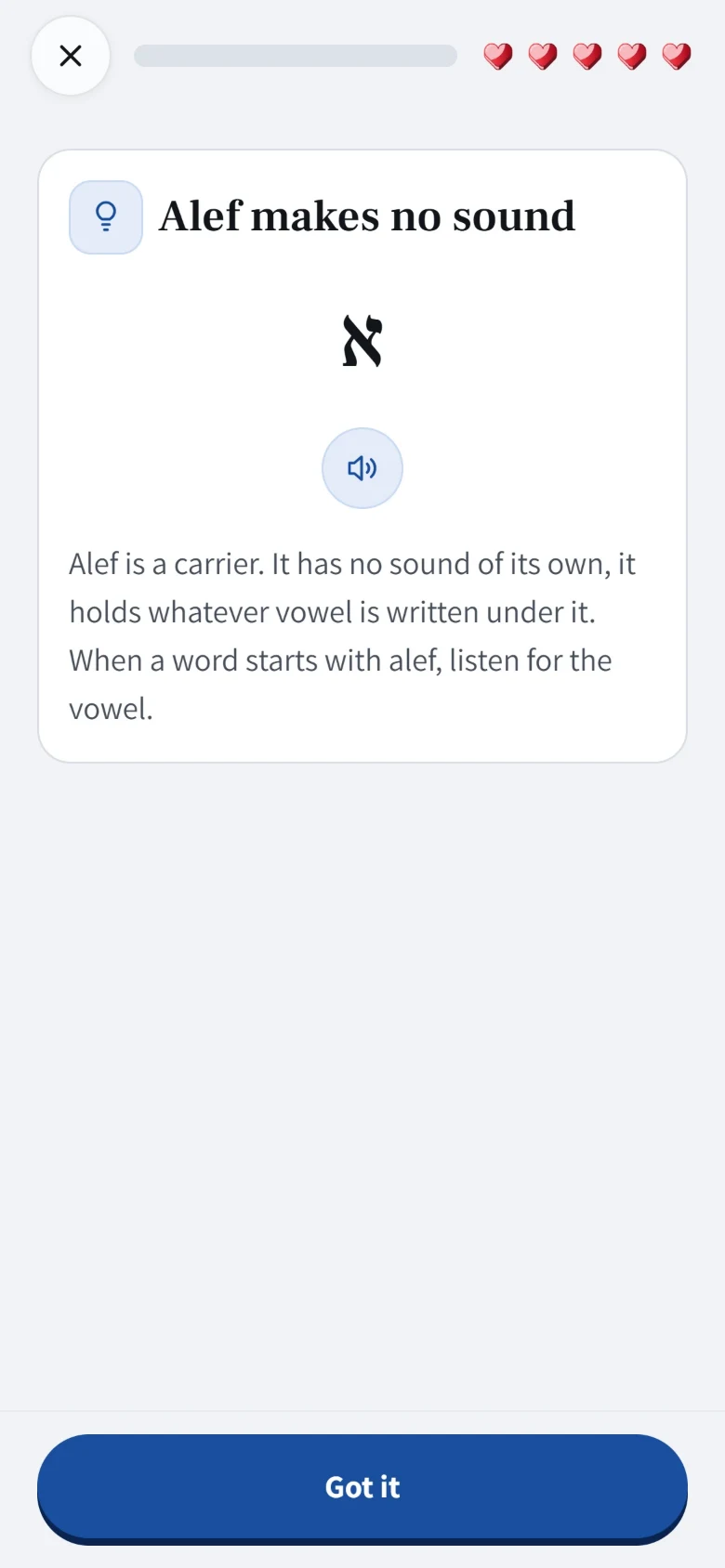
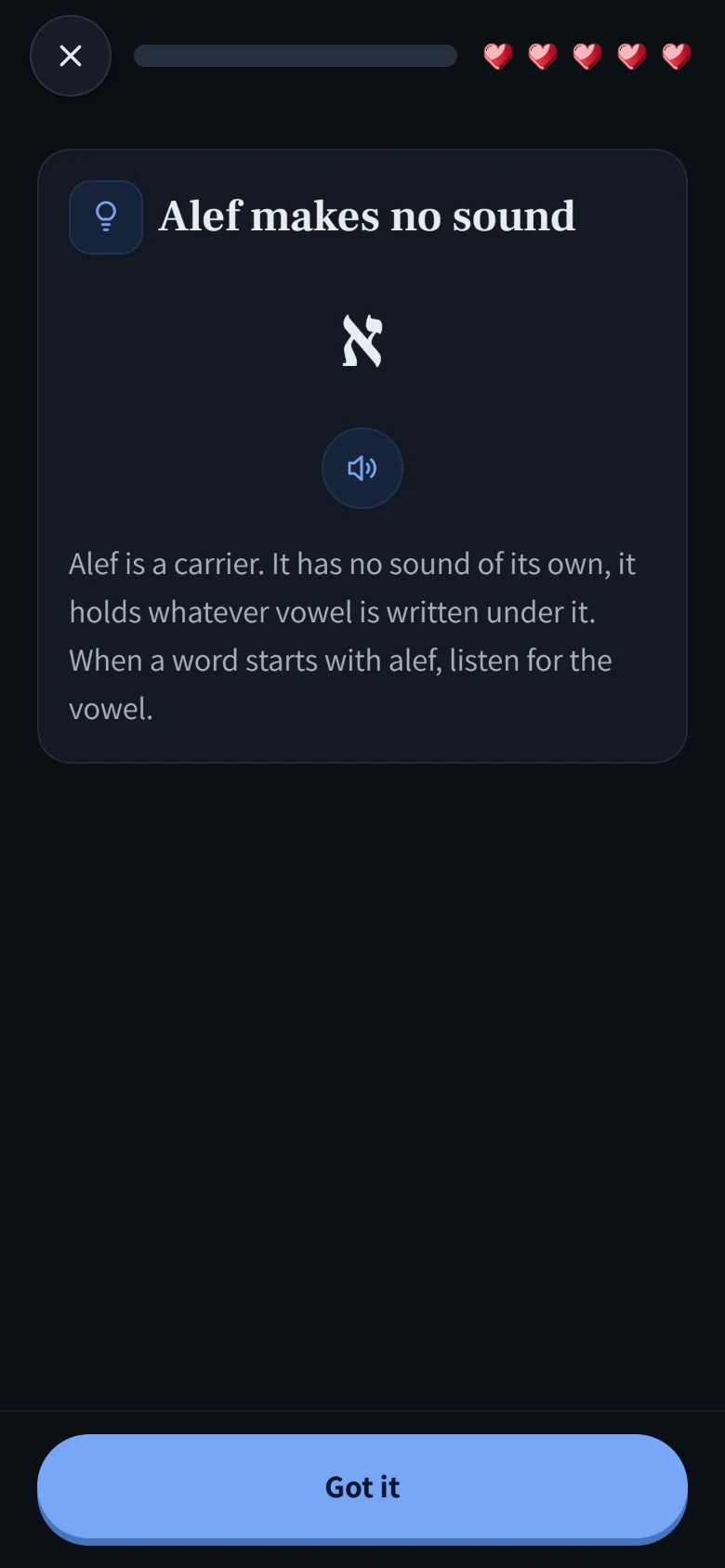
Where are you starting?
Five answers, a path for each. In every bar, each unit and each book of the Torah is one segment, sized by its lessons.
-
I have never seen Hebrew letters
151 lessons: 70 language, 81 Torah. The first Torah lesson is number 71.
- Units 1 to 14
- Bereshit to Devarim
-
I know the alef-bet
151 lessons: 70 language (10 marked as known), 81 Torah. The first Torah lesson is number 71.
- Units 1 and 2, marked as known
- Units 3 to 14
- Bereshit to Devarim
-
I can read slowly
With the vowel points
151 lessons: 70 language (15 marked as known), 81 Torah. The first Torah lesson is number 16.
- Units 1 to 3, marked as known
- Bereshit
- Units 4 to 6
- Shemot
- Units 7 to 9
- Vayikra
- Units 10 to 12
- Bamidbar
- Units 13 and 14
- Devarim
-
I read comfortably
Without the vowel points
136 lessons: 55 language, 81 Torah. It opens with the Torah.
- Bereshit to Devarim
- Units 4 to 14
Units 1 to 3 are left off the path.
-
Hebrew is my language
81 lessons, all Torah.
- Bereshit to Devarim
All 14 language units are left off the path.
These counts are for a teenage or adult learner. A child’s path leaves out the Akedah (the binding of Yitzchak) and is three lessons shorter.
The 14 units
The language track: 70 lessons, five in each unit, written in English.
-
Unit 1
The Alef-Bet, Part One
Your first eleven letters.
Hebrew reads right to left: twenty-two letters, no capitals. Start with the first eleven and the pairs that look alike.
- Alef, Bet, Vet
- Gimel, Dalet, He
- Vav, Zayin, Chet
- Tet, Yod, Kaf
- Checkpoint: Alef to Kaf
-
Unit 2
The Alef-Bet, Part Two
The rest of the letters, and the five that change at the end.
Lamed to tav, plus the five letters that change shape at the end of a word.
- Lamed, Mem, Nun
- Samech, Ayin, Pe
- Tsadi, Kof, Resh
- Shin, Sin, Tav
- Checkpoint: All Twenty-Two
-
Unit 3
Vowels
The dots and dashes that make Hebrew speakable.
Nikkud: the marks under, above and inside the letters. Learn them, and any pointed text can be read aloud, even words you have never met.
- Kamatz and Patach
- Tsere and Segol
- Chirik, Cholam, Shuruk
- Shva, Dagesh and the Hurried Vowels
- Checkpoint: Reading Out Loud
-
Unit 4
First Words
Hello, thank you and how to ask for things.
The words you will use on day one: greeting someone, thanking them and asking for what you need without switching to English.
- Hello and Goodbye
- Thank You, Please, Sorry
- Story: A Table on Friday Night
- Asking for Things
- Checkpoint: Your First Conversation
-
Unit 5
Landing
Ben Gurion to your first night.
From the ramp down to passport control, to a taxi meter, to a hotel key and a quiet first night.
- Passport Control
- Story: The Ramp at Ben Gurion
- Getting Into Town
- Checking In
- Checkpoint: Day One
-
Unit 6
Market and Money
Numbers, prices and how not to overpay.
Hebrew numbers carry gender, and it runs the opposite way from what you would expect. Learn the two sets, then take them to a market stall.
- One to Ten
- Masculine or Feminine
- Shekels and Agorot
- In the Shuk
- Checkpoint: Market and Money
-
Unit 7
At the Table
Ordering, kashrut and what is on your plate.
How to order, how keeping meat and dairy apart works, what the certificate on the wall means and how to ask what is in a dish without causing a scene.
- Ordering
- Meat, Milk and Parve
- What Is in It
- Street Food
- Checkpoint: At the Table
-
Unit 8
Shabbat
What happens when the country stops.
Candles, Kiddush, the greetings and the practical business of a country where the buses stop on Friday afternoon and start again after dark on Saturday.
- Erev Shabbat
- Candles and Kiddush
- Friday Afternoon
- When the Buses Stop
- Checkpoint: Shabbat
-
Unit 9
The Synagogue
How to walk in, where to sit, what to expect.
The room and its furniture, who does what, the rites that differ from one community to the next and what a visitor should do when they have no idea what is happening.
- The Room
- Who Does What
- Nusach and Movement
- Walking In
- Checkpoint: The Synagogue
-
Unit 10
Jerusalem: The Old City
Four quarters, one square kilometre.
Walled, stepped and layered. Learn the names in Hebrew, the shape of the map and what you are looking at when you reach the Western Wall.
- The Four Quarters
- The Gates
- Place: The Western Wall
- Har HaBayit and the Lanes
- Checkpoint: The Old City
-
Unit 11
The Jewish Year
Twelve months and the days that shape them.
A lunisolar year: twelve months, an extra month seven times in nineteen years, six fasts and a set of greetings that change every few weeks. Walk it from Tishrei.
- The Year Starts in Autumn
- Tishrei
- Fast or Festival
- The Second Day
- Checkpoint: The Jewish Year
-
Unit 12
Blessings and Milestones
The words for the moments that matter.
Almost every Jewish blessing opens with the same six words and then changes. Learn the frame, the blessings over bread and wine, the one said for firsts and the vocabulary of a birth, a wedding and a death.
- The Shape of a Blessing
- Bread and Wine
- Shehecheyanu
- Story: The Same Room
- Checkpoint: Blessings and Milestones
-
Unit 13
Reading the Script
From printed letters to a Torah scroll.
Israeli print leaves out the vowel points; a Torah scroll leaves out even more. Learn to read bare Hebrew, then learn what a scribe puts on parchment and how a reader is kept on track.
- Reading Without Points
- Same Words, No Points
- The Sofer’s Hand
- How a Reader Is Prompted
- Checkpoint: Reading the Script
-
Unit 14
Diaspora Roots
Prague, Toledo, Marrakech and the Lower East Side.
Two Jewish languages, an expulsion, a walled quarter in Morocco, a tenement district in New York and a synagogue in Prague that has been in use since the thirteenth century.
- Yiddish and Ladino
- 1492
- The Mellah
- Place: The Prague Jewish Town
- Checkpoint: Diaspora Roots
Then the Torah
After Unit 14, a beginner’s path goes through the five books of the Torah: 81 lessons, starting at lesson 71.
Last updated:
OrQuest is coming to iPhone and Android.
One email, when OrQuest reaches the app stores.