Torah passages, verse by verse
From Bereshit to Devarim, all five books of the Torah: 29 of the app’s 30 passages (132 of its 135 verses). Each verse is given in Hebrew with a transliteration and a plain translation, then explained for a child, a teen and an adult. “Hineni: The Binding” is for teens and adults only, since the app’s plan for ages 7 to 11 leaves it out. The thirtieth, Shemot 20:1-3, waits until its text passes the letter-by-letter check.
Commentators cited by name: Rashi in every passage, Ramban in 26, Ibn Ezra in 17, Rambam in 16, Sforno in 8, Rashbam in 4, Onkelos and Or HaChaim in 3 each.
Bereshit (Genesis)
Beginnings. A world spoken into being, a family chosen for no stated reason and the long argument between brothers that ends in a room in Egypt.
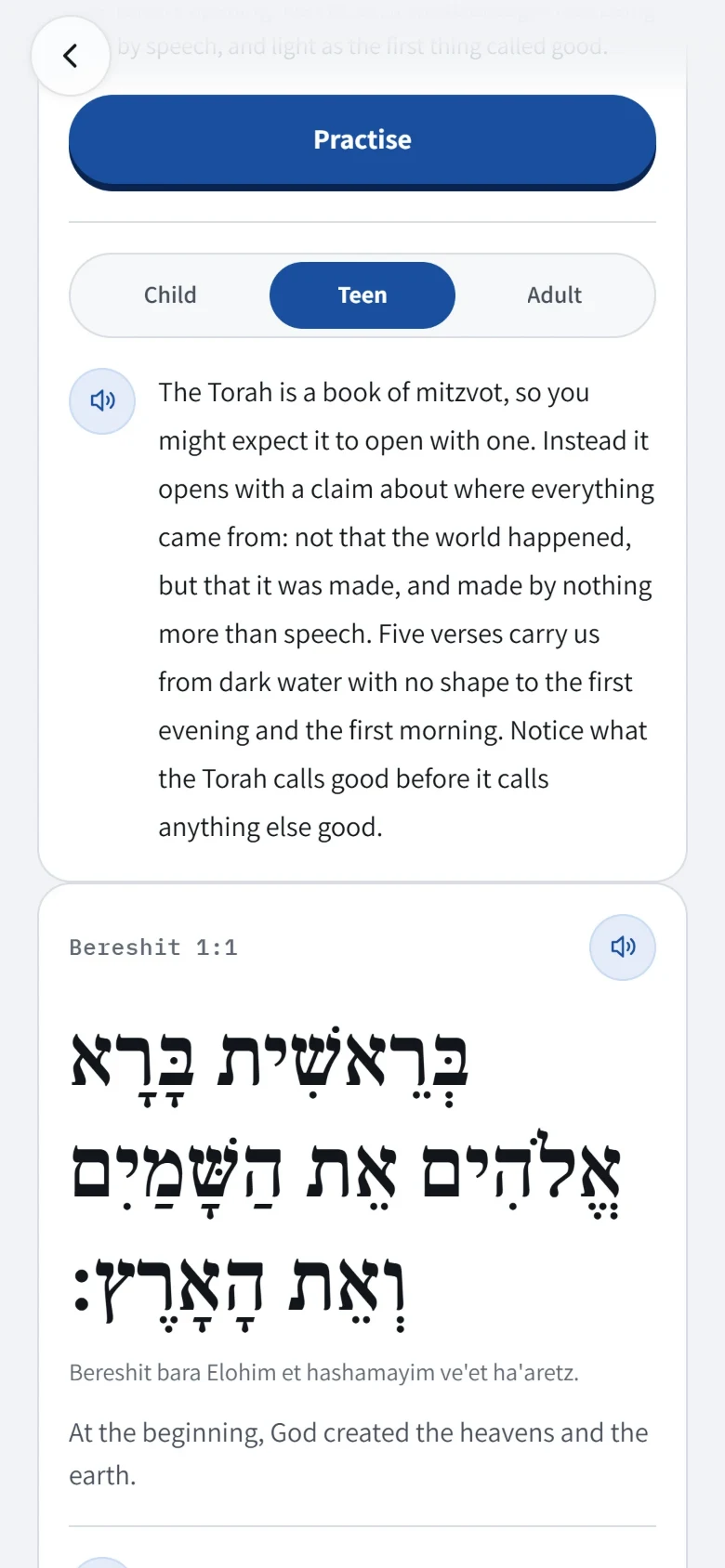
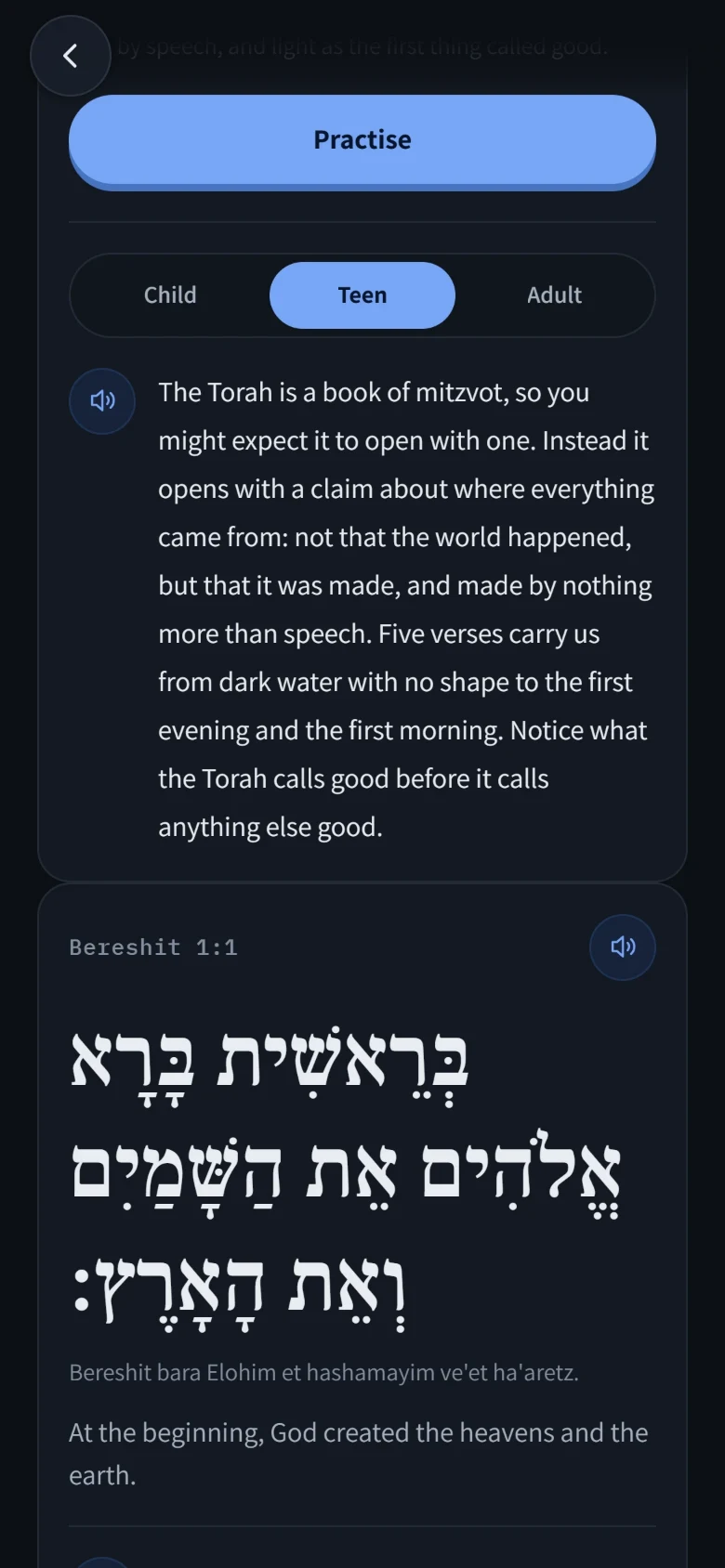
- Parashat Bereshit · Bereshit 1:1-5The First Dayיוֹם אֶחָדThe Torah’s opening five verses: a world brought into being by speech, and light as the first thing called good.
- Parashat Bereshit · Bereshit 2:1-3The Seventh Dayוַיְכֻלּוּ הַשָּׁמַיִםThe three closing verses of creation, in which God ceases from the work, blesses the seventh day and makes it holy.
- Parashat Lech Lecha · Bereshit 12:1-3Go, for Yourselfלֶךְ־לְךָHashem’s first call to Avram: leave your land for a land He does not yet name, and become a blessing to the world.
- Parashat Vayera · Bereshit 22:1-2, 11-12Hineni: The Bindingעֲקֵדַת יִצְחָקHashem calls Avraham, Avraham answers hineni and an angel stops him before the boy is touched.For teens and adults
- Parashat Vayetzei · Bereshit 28:10-12, 15-16The Ladder at Beit Elחֲלוֹם הַסֻּלָּםYaakov leaves home alone, sleeps on open ground and dreams of a ladder joining earth to heaven.
- Parashat Vayigash · Bereshit 45:3-5I Am Yosefאֲנִי יוֹסֵףYosef drops the disguise before his brothers, names what they did to him and tells them God sent him ahead to keep them alive.
Shemot (Exodus)
A people made out of slaves. A bush that burns and is not burnt up, a sea that opens and a mountain where the whole nation hears the same voice.
- Parashat Shemot · Shemot 3:1-6The Bush That Burnsהַסְּנֶה הַבֹּעֵרMoshe, shepherding at the edge of the wilderness, turns aside to a bush that burns without being consumed, and is called by name.
- Parashat Shemot · Shemot 3:13-15Ehyeh Asher Ehyehאֶהְיֶה אֲשֶׁר אֶהְיֶהAt the burning bush Moshe asks for God’s name, and receives a verb in the future tense: I will be.
- Parashat Bo · Shemot 12:1-2, 26-27This Month Is Yoursהַחֹדֶשׁ הַזֶּה לָכֶםIsrael’s first mitzvah as a nation is a calendar, and Seder night is built around a child’s question.
- Parashat Beshalach · Shemot 15:1-2, 11The Song at the Seaשִׁירַת הַיָּםSafe on the far shore, Israel sings the Torah’s first song and vows to glorify God: “This is my God, and I will beautify Him.”
- Parashat Ki Tisa · Shemot 31:16-17And They Shall Keepוְשָׁמְרוּ בְנֵי־יִשְׂרָאֵלTwo verses said every Shabbat, in prayer and at Kiddush: the day is an everlasting covenant and a standing sign between God and Israel.
Vayikra (Leviticus)
The book of coming close. Offerings, purity and a chapter of laws that begins “You shall be holy” and immediately talks about your parents, the wages you owe and your neighbour.
- Parashat Vayikra · Vayikra 1:1-2He Called by Nameוַיִּקְרָא אֶל־מֹשֶׁהHashem calls Moshe by name from the Tent of Meeting and opens the laws of the offerings, whose very name means drawing near.
- Parashat Shemini · Vayikra 11:1-4, 44-45Make Yourselves Holyוְהִתְקַדִּשְׁתֶּם וִהְיִיתֶם קְדֹשִׁיםThe two signs of a permitted animal, and the one reason the Torah gives for them at the end of the chapter.
- Parashat Acharei Mot · Vayikra 16:29-34The Day Itself Atonesבַיּוֹם הַזֶּה יְכַפֵּרThe end of the Yom Kippur chapter, where one man’s ceremony becomes a fixed date, a fast and a duty that falls on everybody.
- Parashat Kedoshim · Vayikra 19:1-4You Shall Be Holyקְדֹשִׁים תִּהְיוּThe opening of Parashat Kedoshim: the whole assembly is told to be holy, and the first examples given are parents and Shabbat.
- Parashat Kedoshim · Vayikra 19:16-18Love Your Neighbourוְאָהַבְתָּ לְרֵעֲךָ כָּמוֹךָThree verses in Kedoshim that turn how you feel about another person into something you must actually do.
- Parashat Behar · Vayikra 25:1-7The Land Keeps Shabbatוְשָׁבְתָה הָאָרֶץSeven verses given at Sinai that hand the ground itself a Shabbat, in a law whose next round of argument reaches Israeli shops in 2028.
Bamidbar (Numbers)
Forty years in open country. A people counted one by one, blessed three lines at a time and undone by a report from ten men who saw the land and lost their nerve.
- Parashat Naso · Bamidbar 6:22-27So Shall You Blessכֹּה תְבָרְכוּThe fifteen words the priests were given to say over Israel, and the oldest biblical verses ever found.
- Parashat Shelach · Bamidbar 13:1-2, 30-33Like Grasshoppers in Our Eyesוַנְּהִי בְעֵינֵינוּ כַּחֲגָבִיםThe report that kept a generation out of the land, and the one clause in it that describes the spies rather than the giants.
- Parashat Shelach · Bamidbar 15:37-41Do Not Follow Your Heartוְלֹא־תָתוּרוּ אַחֲרֵי לְבַבְכֶםThe third paragraph of the Shema: a garment law that turns, mid-sentence, into a law about where you let your eyes take you.
- Parashat Korach · Bamidbar 16:1-5All of Them Holyכֻּלָּם קְדֹשִׁיםFive verses in which a rebellion opens with an argument that is very nearly true.
- Parashat Chukat · Bamidbar 20:7-12Speak to the Rockוְדִבַּרְתֶּם אֶל־הַסֶּלַעSix verses in which Moshe loses the land, and the commentators cannot agree on what exactly he did wrong.
- Parashat Balak · Bamidbar 22:28-31, 24:5The Donkey and the Blessingמַה־טֹּבוּ אֹהָלֶיךָ יַעֲקֹבA hired seer is out-seen by his own donkey, and ends up saying the line many Jews say on walking into a synagogue.
Devarim (Deuteronomy)
Moshe, in the last weeks of his life, saying everything that matters. The Shema, the courts and the choice, and a Torah that ends one river short of the land.
- Parashat Vaetchanan · Devarim 6:4-9Hear, O Israelשְׁמַע יִשְׂרָאֵלSix verses whose first line nearly every Jewish child knows, written by hand inside the mezuzah on the doorpost.
- Parashat Eikev · Devarim 11:13-17If You Truly Listenוְהָיָה אִם־שָׁמֹעַ תִּשְׁמְעוּThe second paragraph of the Shema: five verses that tie the rain over a whole country to the conduct of the people who live there.
- Parashat Reeh · Devarim 15:7-11Open Your Handפָּתֹחַ תִּפְתַּח אֶת־יָדְךָFive verses in Re’eh that make giving a law, including a law against the calculation that talks you out of it.
- Parashat Shoftim · Devarim 16:18-20Justice, Justiceצֶדֶק צֶדֶק תִּרְדֹּףThree verses that set up a judiciary, warn it about itself and then repeat one word, leaving the commentators divided over why.
- Parashat Nitzavim · Devarim 30:15-20Therefore Choose Lifeוּבָחַרְתָּ בַּחַיִּיםJust before the people cross the Jordan without him, Moshe puts two roads in front of them and tells them outright which one to take.
- Parashat Vezot Haberachah · Devarim 34:5-6, 10-12The Death of Mosheוַיָּמָת שָׁם מֹשֶׁהThe Torah’s closing verses: Moshe dies in Moav, no one knows where he is buried and the book stops one river short of the land.
The verses are from Miqra according to the Masorah (Wikisource, CC BY-SA 4.0), via Sefaria, without the cantillation marks. On this site the four-letter Name is written ה׳.
OrQuest is coming to iPhone and Android.
One email, when OrQuest reaches the app stores.