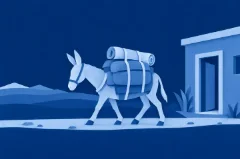
The OrQuest app tells two stories from Parashat Lech Lecha (Abram’s journey to Canaan and the parting from Lot) and explains one of its passages verse by verse.
When it is read in Israel
13 Cheshvan 5787
13 Cheshvan 5788
8 Cheshvan 5789
11 Cheshvan 5790
This calendar runs until 21 September 2030.
The Israeli reading calendar is from Hebcal (CC BY 4.0), checked against Sefaria.
God calls Avram to leave his land and father’s house for a land He has not yet shown him.
What it teaches
Faith. Believing in God and walking in His way even without understanding everything.
God calls Avram to a land He does not name, with promises for the future. The Torah does not describe what Avram thought or felt, but what he did: he went as God had spoken to him, and along the way he built altars. So the Torah teaches that faith shows itself in deeds, even when one holds only a promise.
The lesson
Faith does not wait for a map: it sets out on a promise.
Avram said to Lot, “Please, let there be no quarrel between me and you, or between my herdsmen and your herdsmen, for we are brothers.”
What it teaches
Pursuing peace. Seeking peace between people, and giving way so it can last.
When the herdsmen quarrelled, Avram spoke to Lot without blaming anyone. He reminded him that they were brothers and gave Lot the choice. The Torah teaches that pursuing peace can mean giving up the right to choose, and that sometimes peace is kept by parting without a quarrel.
The lesson
When space is tight for two, whoever pursues peace lets the other choose first.
Hashem’s first call to Avram: leave your land for a land He does not yet name, and become a blessing to the world.
For children, teens and adults
Up to now the Torah has been telling the story of the whole world: Adam, Noach, the tower, the nations. Suddenly it narrows to one man in Charan, and it does not first tell us why he was chosen. Hashem simply speaks to Avram and asks him to walk away from his country, his town and his family, towards a place He does not even name. Everything that follows in the Torah starts with whether he goes.
The verses are from Miqra according to the Masorah (Wikisource, CC BY-SA 4.0), via Sefaria, without the cantillation marks. On this site the four-letter Name is written ה׳.