Moshe urges the people to ask their fathers and elders, and to command their children to keep the Torah.
The story
Moshe recites a song to the people. It calls on them to remember the days of old and to consider the years of generation after generation. It also tells them whom to ask: their father and their elders, who will tell them.
The song goes on: when God gave the nations their inheritance, His own portion was His people, Yaakov. He found him in a desert land, in an empty, howling waste, surrounded him, watched over him and guarded him like the pupil of His eye.
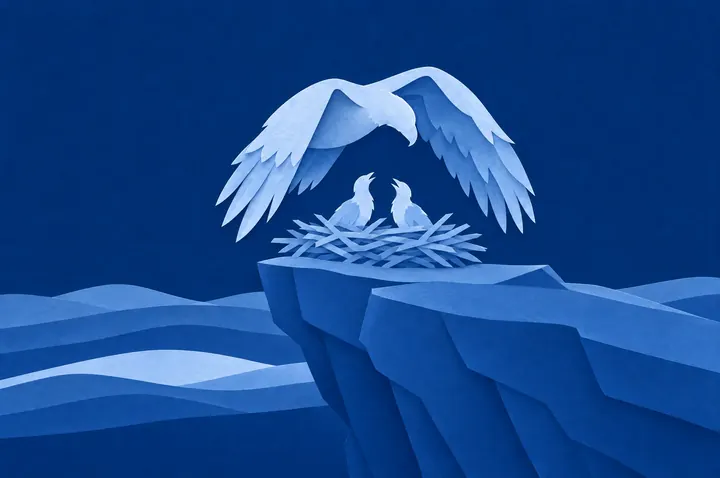
Then the song offers the image of an eagle that stirs its nest and hovers over its young. It spreads its wings, takes up a fledgling and carries it on its wing. So God alone guided His people, and no foreign god was with Him.
After the song, the Torah returns to the scene: Moshe recited the whole song to the people, together with Hoshea son of Nun. The Torah does not spell out what Hoshea’s part was. When Moshe finished speaking to all Israel, he spoke to them again.
“Take to heart all the words with which I warn you today,” he said, “and charge your children with them, so they keep and do everything written in this Torah. For it is not an empty thing for you, it is your life. Through it you will live long in the land you are crossing the Jordan to possess.”
Remember the days of old, consider the years of generation after generation. Ask your father, and he will tell you, your elders, and they will tell you.
Words from the verse
עוֹלָםancient times, not “the world”
בִּינוּconsider, reflect on
וְיַגֵּדְךָand he will tell you
What it teaches: Passing on the tradition
Receiving the tradition from parents and elders and passing it on to the next generation.
In these verses the tradition does not pass on by itself: you ask your father and your elders, you listen to them and you hand the words on to your children. It passes from person to person. And Moshe says these words are no empty thing: they are the people’s very life.
A question to sit with
What have you received from parents, grandparents or teachers that you would like to pass on?
Questions about the story
According to the song, whom do you ask about the days of old?
Priests and Levites
Fathers and elders
Kings and judges
Answer
b. Fathers and elders
The song sends the listener to ask his father and his elders, and they will tell him.
What does Moshe ask the people to do with the words he has spoken to them?
Leave them behind in the desert
Teach them to the nations of the land
Command their children to keep them
Answer
c. Command their children to keep them
Moshe told them to take the words to heart and charge their children with them, so they keep and do everything written in this Torah.
The lesson
Every generation stands in the middle, asking the one before and handing on to the next.
For this week
This week, try asking a parent, grandparent or another older person to share one memory from long ago, and pass it on to someone younger than you.
From the sources
Rashi explains that the song was recited on a Shabbat when authority was taken from Moshe and given to Hoshea son of Nun, that is Yehoshua. Moshe gave Yehoshua a spokesman so he could teach in Moshe’s lifetime, “so that Israel would not say: in your master’s lifetime you could not raise your head.” In his reading, Moshe handed on more than words: he handed on his place.
The verses are from Miqra according to the Masorah (Wikisource, CC BY-SA 4.0), via Sefaria, without the cantillation marks. On this site the four-letter Name is written ה׳.