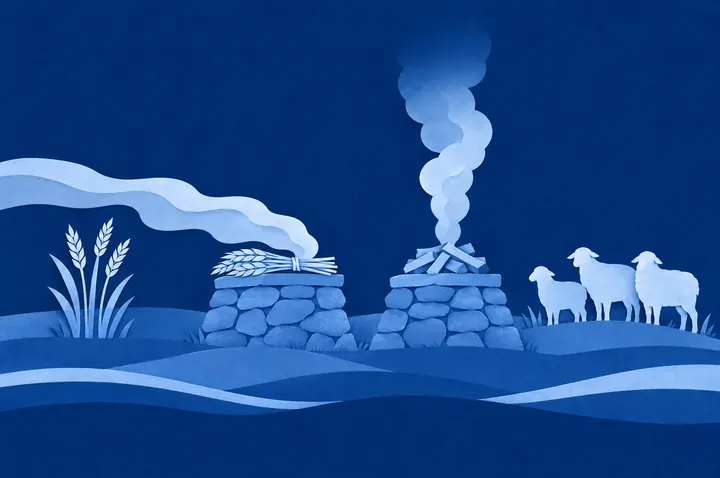
Two brothers, two offerings and a question God asks Kayin: “Where is your brother?”
The story
Chava, Adam’s wife, gives birth to Kayin, and then to his brother Hevel. Hevel becomes a shepherd, and Kayin works the ground. Two brothers, two ways of life.
After some time, Kayin brings God an offering from the fruit of the ground. Hevel brings one too, from the firstborn of his flock and from their fat. God turns with favour to Hevel and his offering, but not to Kayin and his. The Torah does not say why. Kayin is very angry, and his face falls.
וְאֶל־קַיִן וְאֶל־מִנְחָתוֹ לֹא שָׁעָה
Bereshit 4:5
God asks Kayin why he is angry and why his face has fallen. He speaks to him of two paths, doing well or not, and tells him: if you do not do well, sin crouches at the door, longing for you, and you will rule over it.
Kayin says something to his brother Hevel, and the Torah does not tell us what. When they are in the field, Kayin turns on his brother Hevel and kills him. Then God asks Kayin where his brother Hevel is. Kayin answers that he does not know, and asks whether he is his brother’s keeper.
וַיֹּאמֶר קַיִן אֶל־הֶבֶל אָחִיו
Bereshit 4:8
God says to Kayin, “What have you done? Your brother’s blood cries out to Me from the ground. Now you are cursed from the ground, and you will wander the earth.” Kayin says whoever finds him will kill him. God sets a sign for Kayin so no one who finds him strikes him. Kayin leaves and settles in Nod.
God said to Kayin, “Where is Hevel your brother?” And he said, “I do not know. Am I my brother’s keeper?”
Words from the verse
אֵיwhere
הֲשֹׁמֵרkeeper? (the prefix makes it a question)
What it teaches: Mutual responsibility
Caring about another person’s fate as if it were your own.
God asks Kayin a simple question, where his brother is, and Kayin says he does not know and asks whether he is his brother’s keeper. God does not leave that question hanging: the brother’s blood cries out from the ground. Saying “I don’t know” does not free a person from what happens to his brother.
A question to sit with
Which person close to you is it easiest to say “I don’t know” about, and what would change if you checked?
Questions about the story
What reason does the Torah give for God turning with favour to Hevel and not to Kayin?
Kayin’s offering was smaller
Kayin brought his offering after Hevel
The Torah gives no reason
Answer
c. The Torah gives no reason
The verses tell us what each brother brought, and that God turned with favour to Hevel and his offering and not to Kayin and his. They give no reason.
What does Kayin answer when God asks him where his brother Hevel is?
That he does not know where Hevel is
That Hevel went out to tend the flock
That Hevel stayed behind alone in the field
Answer
a. That he does not know where Hevel is
Kayin answers that he does not know, and adds a question of his own: is he his brother’s keeper?
The lesson
When someone asks where your brother is, “I don’t know” is no answer.
For this week
This week, try calling one person you haven’t heard from in a while (a sibling, a friend, a neighbour), ask how they are and really listen to the answer.
From the sources
The Mishnah in Sanhedrin notices that the verse says “bloods,” in the plural, and not “blood.” The sages read it as “his blood and the blood of his descendants,” the blood of Hevel and of all the generations that would have come from him.
The verses are from Miqra according to the Masorah (Wikisource, CC BY-SA 4.0), via Sefaria, without the cantillation marks. On this site the four-letter Name is written ה׳.