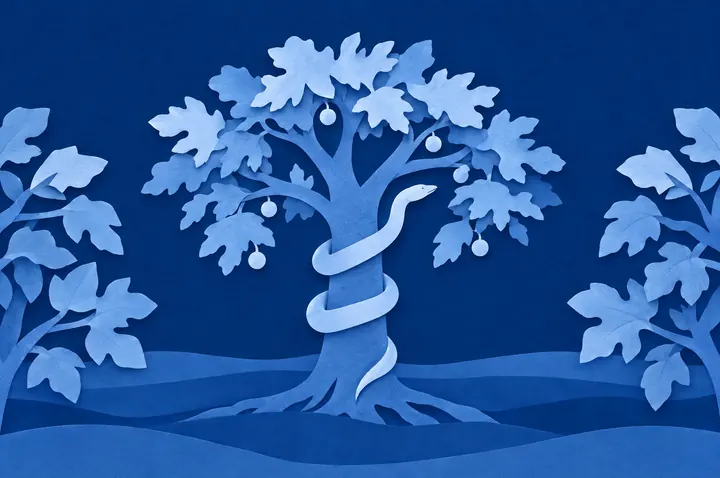
God calls to the man in the garden, and the answers pass the blame along.
The story
The snake, more cunning than any wild animal God made, asks the woman whether God really said not to eat from any tree in the garden. She answers that they eat the fruit of the garden’s trees, but that God said not to eat from the tree in the middle of the garden or touch it, or they would die.
לֹא תֹאכְלוּ מִמֶּנּוּ וְלֹא תִגְּעוּ בּוֹ
Bereshit 3:3
The snake answers: You will not die. God knows that on the day you eat from it your eyes will be opened, and you will be godlike, knowing good and evil. The woman sees the tree is good to eat and pleasing to the eye. She takes some of its fruit and eats, gives her husband some, and he eats.
The eyes of both of them are opened, and they know that they are naked. They sew fig leaves together and make themselves loincloths. They hear the voice of God in the garden, and the man and his wife hide from God among the trees of the garden.
God asks: Who told you that you are naked? Have you eaten from the tree I commanded you not to eat from? The man answers: The woman You gave to be with me, she gave me some from the tree, and I ate. God asks the woman: What have you done? She answers: The snake deceived me, and I ate.
God called to the man and said to him: Where are you?
Words from the verse
אֶל־הָאָדָםto the man
אַיֶּכָּהwhere are you
What it teaches: Responsibility
Owning what you did and what is in your power to do.
The man and his wife hide, and when God asks, the man points to the woman and the woman to the snake. Only at the end of their words does each of them say that they ate. From this we can learn that responsibility begins when the first thing we say is what we did.
A question to sit with
When something goes wrong, what comes first for me: what I did, or who else is to blame?
Questions about the story
According to what the woman told the snake, what were they told about the tree in the middle of the garden?
Not to eat from it or look at it
Not to eat from it or go near it
Not to eat from it or touch it
Answer
c. Not to eat from it or touch it
The woman told the snake that about the tree in the middle of the garden, God said not to eat from it or touch it.
When God asked the man where he was, what did the man leave out of his answer?
That he heard the voice in the garden
That he had eaten from the tree
That he was afraid because he was naked
Answer
b. That he had eaten from the tree
The man said that he heard the voice, that he was afraid because he was naked and that he hid. About the tree he said nothing.
The lesson
Blaming someone else is another way of hiding.
For this week
This week, when something goes wrong at home or at work, try starting with what you yourself did, and only then mention anyone else.
From the sources
Sforno dwells on the man’s words. As he reads them, the man is really saying that the woman God gave him “became a stumbling block,” and so he “attributed his guilt to his Maker,” laying the blame on God. He did this instead of repenting as was fitting for him, the way King David did when he said to Natan the prophet, “I have sinned.”
The verses are from Miqra according to the Masorah (Wikisource, CC BY-SA 4.0), via Sefaria, without the cantillation marks. On this site the four-letter Name is written ה׳.