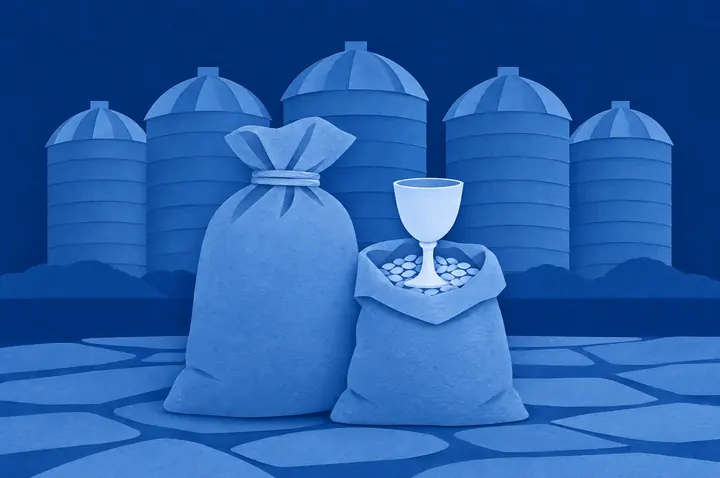
Yehuda approaches the man, “for you are like Pharaoh,” and offers himself as a slave in his brother’s place.
The story
Yehuda steps up to the man, calls him “my lord” and asks to speak with him. Calling himself “your servant,” he asks the man not to be angry with him, because, he says, the man is like Pharaoh. Then he recalls that the man had asked them whether they had a father or a brother.
וַיִּגַּשׁ אֵלָיו יְהוּדָה
Bereshit 44:18
Yehuda continues: they told of an old father with a young son of his old age. The boy’s brother is dead, he alone is left of his mother, and his father loves him. The man ordered him brought down. They said the lad could not leave his father, and the man said without him they would not see his face again.
לְבַדּוֹ לְאִמּוֹ וְאָבִיו אֲהֵבוֹ
Bereshit 44:20
They told their father all this. He sent them back for a little food. They said they could not go down without their youngest brother. He reminded them his wife bore him two: one left him, surely torn apart, he said. If they took this one too and harm came, they would bring him to the grave in misery.
Now, Yehuda says, when he comes to his father without the lad, his father will see the lad is gone and die, since one’s soul is bound up in the other’s. For Yehuda vouched for the lad to his father, saying if he did not bring him back, he would bear the blame before his father for all time.
עַבְדְּךָ עָרַב אֶת־הַנַּעַר מֵעִם אָבִי
Bereshit 44:32
Then comes the request itself: Yehuda asks to stay as a slave to the man in place of the lad, and that the lad go up with his brothers. For how can he go up to his father without the lad? He could not bear to see the harm that would come upon his father.
So now, please, let your servant stay as a slave to my lord in place of the lad, and let the lad go up with his brothers.
Words from the verse
יֵשֶׁב־נָאlet him stay, please
תַּחַתinstead of
יַעַלlet him go back up
What it teaches: Self-sacrifice
Giving up what is most precious to you for the sake of Heaven or of someone else.
Yehuda is ready to give up his own freedom so the lad can go up with his brothers to their father. The Torah shows here a self-sacrifice born of responsibility: a man who vouched for another keeps his word, whatever it costs him. It also grows from being unable to watch his father come to harm.
A question to sit with
Who are you answerable for in your life, and what would you give of yourself to protect them?
Questions about the story
What did the brothers tell the man about the father and the lad?
That the lad still lives with his mother
That the lad works the fields with his father
That the lad’s father loves him
Answer
c. That the lad’s father loves him
Yehuda says the lad’s brother is dead, that he alone is left of his mother, and that his father loves him. Nothing is said about living with his mother or working the fields.
What did Yehuda tell his father when he vouched for the lad?
If he failed, he’d be guilty before his father forever
If he failed, he’d pay his father a large sum
All the brothers together would keep the lad safe
Answer
a. If he failed, he’d be guilty before his father forever
Yehuda says he vouched for the lad and told his father that if he did not bring him back, he would bear the blame before him for all time. Nothing is said about money or the other brothers.
The lesson
Whoever truly vouches for someone is ready to take their place.
For this week
This week, you can pick one promise you made to someone close and keep it all the way, even when it isn’t convenient.
From the sources
Rashi explains, as if in Yehuda’s own voice, why he steps into the fray more than any of his brothers. The others stand outside, but Yehuda, the lad’s guarantor, says: “I have bound myself with a strong bond.” By Rashi’s reading, he bound himself to be an outcast in this world and the next if he did not bring the lad back.
The verses are from Miqra according to the Masorah (Wikisource, CC BY-SA 4.0), via Sefaria, without the cantillation marks. On this site the four-letter Name is written ה׳.