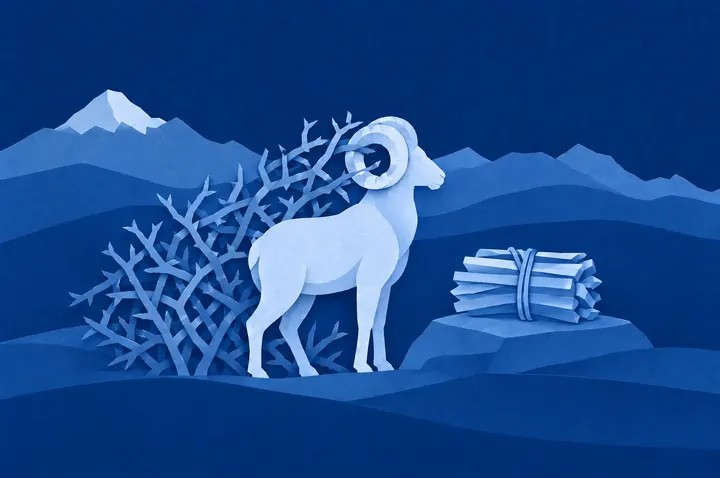
God calls Avraham, who answers “Here I am” and sets out with his son for Moriah.
The story
God puts Avraham to the test. He calls him by name, and Avraham answers “Here I am” before he knows what will be asked. Then the command comes: to take his son, his only one, the one he loves, Yitzchak, and offer him up in the land of Moriah, on a mountain God will point out to him.
Avraham rises early, saddles his donkey, takes his two young men and Yitzchak, splits wood for the offering and sets out. On the third day he sees the place from afar. He tells the young men to wait with the donkey: he and Yitzchak will go, worship and return. The Torah does not say why he says both will return.
Avraham places the wood on Yitzchak and takes the fire and the knife in his hand. The two walk on together. Yitzchak says, “My father,” and Avraham answers, “Here I am, my son.” Yitzchak asks where the lamb for the offering is. Avraham answers that God will see to the lamb, and the two walk on together.
אָבִי וַיֹּאמֶר הִנֶּנִּי בְנִי
Bereshit 22:7
When they reach the place, Avraham builds an altar, arranges the wood, binds Yitzchak and lays him on the altar. He reaches out his hand and takes the knife. Then an angel of God calls from heaven, and Avraham answers, “Here I am.” The angel says: do not harm the boy, for now I know that you fear God.
Avraham sees a ram caught by its horns in a thicket and offers it in place of his son. The angel calls again with an oath from God: because you did not withhold your son and obeyed Me, I will bless you and multiply your descendants. Avraham returns to his young men, and they go together to Be’er Sheva.
After these things, God tested Avraham. He said to him, “Avraham,” and he answered, “Here I am.”
Words from the verse
נִסָּהput to the test
הִנֵּנִיhere I am
What it teaches: Self-sacrifice
Giving up what is most precious to you for the sake of Heaven or of someone else.
The command does not hide the cost: Yitzchak is the son Avraham loves. The Torah teaches here that self-sacrifice is being ready to hold nothing back from God, even what you love. The Binding of Yitzchak is read in the synagogue on the second day of Rosh Hashanah.
A question to sit with
What is hardest for you to give, and for whom would you give it anyway?
Questions about the story
What did Avraham tell the young men when he saw the place?
To take the donkey and go back home
To wait with the donkey until they return
To follow him and keep watch from afar
Answer
b. To wait with the donkey until they return
Avraham told the young men to stay with the donkey, and said that he and Yitzchak would go, worship and come back to them.
What did Yitzchak ask his father on the way?
Why they had left the young men behind
Where exactly the two were going
Where the lamb for the offering was
Answer
c. Where the lamb for the offering was
Yitzchak said that they had the fire and the wood, and asked where the lamb for the offering was. Avraham answered that God would see to the lamb.
The lesson
Self-sacrifice means not keeping back even what we love.
For this week
This week, when someone close to you calls you, try answering “I’m here” and really listening, even when it is inconvenient.
From the sources
Ramban explains what a test is. God tests the righteous precisely when He knows they will do His will, so that what is potential becomes actual, and they earn “the reward of a good deed, not only the reward of a good heart.” And so, Ramban writes, every test in the Torah is for the good of the one tested.
The verses are from Miqra according to the Masorah (Wikisource, CC BY-SA 4.0), via Sefaria, without the cantillation marks. On this site the four-letter Name is written ה׳.