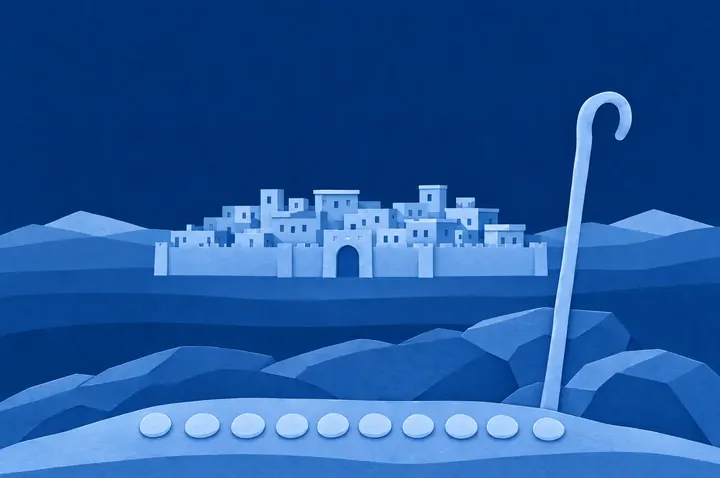
From fifty righteous down to ten: Avraham stands before God and asks for a just judgment.
The story
The men rise from there and look out towards Sodom, and Avraham walks with them to see them off. God says: “Should I hide from Avraham what I am doing?” Avraham, He says, will become a great nation, and will command his children and his household after him to keep the way of God, doing righteousness and justice.
לַעֲשׂוֹת צְדָקָה וּמִשְׁפָּט
Bereshit 18:19
God says: “The outcry of Sodom and Gomorrah is great, and their sin is very grave. I will go down and see whether what they have done matches the outcry that has come to Me. And if not, I will know.” The men turn from there and go towards Sodom, while Avraham is still standing before God.
אֵרְדָה־נָּא וְאֶרְאֶה
Bereshit 18:21
Avraham draws near and asks: will You sweep away the righteous with the wicked? Perhaps there are fifty righteous in the city. Will You sweep it away and not forgive it for the fifty in it? It is unthinkable, he says, that the righteous should share the fate of the wicked. Shall the Judge of all the earth not do justice?
הַאַף תִּסְפֶּה צַדִּיק עִם־רָשָׁע
Bereshit 18:23
God answers that if He finds fifty righteous in Sodom, He will forgive the whole place for their sake. Avraham speaks again, calling himself dust and ashes. What if the fifty are five short, he asks: will You destroy the whole city for five? The answer: if He finds forty-five there, He will not destroy it.
וְאָנֹכִי עָפָר וָאֵפֶר
Bereshit 18:27
Avraham goes on: what if forty are found there? Thirty? Twenty? And one last time, ten. Before raising thirty, and again before ten, he asks God not to be angry. Each time the answer is: He will not destroy. The Torah does not say why it ends at ten. God finishes speaking and goes, and Avraham returns to his place.
Far be it from You to do such a thing, to put the righteous to death with the wicked, so that the righteous fare like the wicked. Far be it from You. Shall the Judge of all the earth not do justice?
Words from the verse
חָלִלָהfar be it, unthinkable
הֲשֹׁפֵטshall the Judge (a question)
מִשְׁפָּטjustice, a fair ruling
What it teaches: Justice
Judging fairly, without favouritism and without rushing.
God says Avraham will command his household to do righteousness and justice, and later Avraham himself asks: shall the Judge of all the earth not do justice? He asks that the righteous and the wicked not share one fate. The Torah teaches that true justice sees the righteous inside the city, and does not judge it as one mass.
A question to sit with
How did it feel when you were punished along with everyone for something you didn’t do?
Questions about the story
What does God say He will do about the outcry from Sodom?
Send Avraham to look into the city
Go down and see what they did
Warn the people of the city first
Answer
b. Go down and see what they did
God says He will go down and see whether what they have done matches the outcry that has come to Him.
What does Avraham say about himself when he speaks to God again?
That he is a faithful servant
That he is a father of many nations
That he is dust and ashes
Answer
c. That he is dust and ashes
Avraham keeps asking, and in the same breath says of himself that he is dust and ashes.
The lesson
True justice does not judge the righteous and the wicked alike, even when they are neighbours.
For this week
Next time something goes wrong at home or at work and you feel like blaming everyone, try first finding out who was actually involved.
From the sources
Rashi cites three places in Scripture where someone “drew near”: Yoav for battle, Yehuda to appease and Eliyahu to pray. Avraham, he says, drew near here for all of these, “to speak harshly, to appease and to pray.” In other words, Avraham is not only arguing here, but also appeasing and praying.
The verses are from Miqra according to the Masorah (Wikisource, CC BY-SA 4.0), via Sefaria, without the cantillation marks. On this site the four-letter Name is written ה׳.